

RESEARCH INTERESTS
My primary research interests lie in the detection and characterization of brown dwarf and gas planet atmospheres, with the aim of advancing our understanding of their chemical composition, physical properties, and atmospheric processes. I am particularly focused on the formation, composition, and evolution of dust clouds in these atmospheres. In addition, I am interested in studies of the stellar and substellar initial mass function in young stellar associations and the solar neighborhood to investigate its origin and the universality of the star and brown dwarf formation process. I am also passionate about contributing to open-source projects.
SOFTWARE DEVELOPMENT
SEDA (Spectral Energy Distribution Analyzer)
SEDA is a versatile open-source Python package I developed for forward modeling and (semi-)empirical analysis of spectral energy distributions of ultracool objects, including brown dwarfs, directly imaged exoplanets, and low-mass stars. SEDA provides atmospheric-model fitting using Bayesian nested sampling and χ² minimization, supporting spectra with different resolutions and photometry across a wide range of wavelengths. It also uses evolutionary models to infer fundamental physical parameters and includes empirical and auxiliary tools for comprehensive SED analysis. The tool as a formal software package is presented in Suárez et al. (2026, AJ submitted), building on the modeling framework introduced in Suárez et al. (2021a).
Check out the documentation at https://seda.readthedocs.io

MY RESEARCH
Brown Dwarfs and Giant Exoplanets
Silicate Clouds in Substellar Atmospheres
I study the formation, evolution, composition, and distribution of silicate clouds in substellar atmospheres. Using mid-infrared spectra from JWST/MIRI and Spitzer/IRS, I have led studies that have advanced our understanding of silicate clouds and their impact on the emergent spectra of brown dwarfs and exoplanets. Key results include:
-
Silicate clouds are near ubiquitous in L-type atmospheres and form, then thicken, and sediment in the 2000–1300 K effective temperature range (Suárez & Metchev 2022).
-
The ~9 μm silicate absorption feature—the only direct observational evidence of silicate clouds—is sensitive to surface gravity (or age), with young atmospheres showing broader, redder, and more asymmetric absorption, potentially indicating iron-rich silicate clouds (Suárez & Metchev 2023, 2026c, in preparation).
-
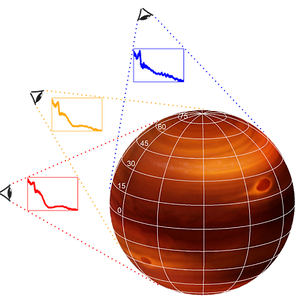
Objects viewed equator-on exhibit higher cloud opacity and redder colors, suggesting that silicate clouds are concentrated at lower latitudes (Suárez et al. 2023).
-
Low-metallicity brown dwarfs lack silicate clouds (Suárez et al. 2026b, ~submitted).

Figure 1: Illustration of the formation and evolution of dust clouds in planetary and brown dwarf atmospheres from a NASA press release on our study in Suárez & Metchev (2022).
Figure 2: Objects viewed equator-on exhibit higher cloud opacity and, therefore, are redder than objects viewed near pole-on (Suárez et al. 2023). Figure from the conference proceedings Suarez et al. (2026).
Testing Atmospheric Models of Ultracool Dwarfs
We assembled in Suárez et al. (2021a) the most comprehensive (0.8–26 μm; see Figure) spectral energy distribution (SED) of an intermediate-gravity L/T transition dwarf. We found that models with condensates clouds and non-equilibrium chemistry better reproduce the full SED and that young (≈0.1–0.3 Gyr) early-T dwarfs on average have ≈140 K lower effective temperatures, ≈20% larger radii, and similar bolometric luminosities compared to old (>1 Gyr) field dwarfs with similar spectral types.
Figure: SED of the T2.5 dwarf HN Peg B using the spectrophotometry indicated in the top legend. The best BT-Settl cloudy atmospheric model fits are shown by the curves indicated in the bottom legend.

Auroral Activity and Atmospheric Heating
Using an extension of the retrieved spectrum of the ~482 K brown dwarf W1935 into the mid-infrared, we predict an additional methane emission feature at 7.7 μm and tentative ammonia emission features, complementing the 3.3 μm methane emission observed with JWST/NIRSpec. We find that the thermal inversion weakens spectral features at ≳2 μm, except for the 4.1–5.0 μm CO₂ and CO features, and that atmospheric heating contributes ~15% of the object's bolometric luminosity. However, the thermal inversion cannot explain the overluminous and/or redder position of W1935 in mid-infrared color–magnitude diagrams (Suárez et al. 2025).

Figure: Observed SED of W1935, including the spectroscopy and photometry in the legend, compared with retrieved spectra with and without an upper-atmospheric thermal inversion. The main molecular features are labeled.
Star Formation
Initial Mass Function (IMF)
As the main product of my PhD thesis project (Suárez, 2019), we present in Suárez et al. (2019) the mass distribution (IMF) of a young stellar association from planetary-mass objects to intermediate/high-mass stars (see Figure). This study represents, to our knowledge, the most complete IMF to date in terms of both mass coverage (0.012–13 Msun) and spatial distribution (up to a 1.1 deg-radius area), and allowed us to investigate the environmental dependence of the IMF.
Figure: System IMF of 25 Ori (differential and continuous representations by the black points and black solid curve) presented in Suárez et al. (2019), which is complete between 0.012 and 13 Msun. The IMF is well represented by the tapered power-law function indicated by the dashed curve.

Core Mass Function (CMF)
To test the idea of a direct connection between the IMF and the CMF, we used in Suárez et al. (2021b) high-resolution ALMA observations to construct the CMF of the massive star-forming clump G33.92+0.11, which turned out to be in agreement with a number of CMFs in diverse star-forming regions. We use Monte Carlo simulations to compare the resulting CMF to the Salpeter IMF and found that they are statistically indistinguishable (see Figure). This result is consistent with the idea that the form of the IMF is inherited from the CMF.
Figure: CMF of G33.92 reported in Suárez et al. (2021b). The best power-law fits to the CMF using different approaches are indicated in the legend.

Press conference at the American Astronomical Society 243:
Extrasolar Worlds Exhibit Exotic Sandy Clouds at the Equator
(2023)
Origins Seminar: Explaining the Diversity of Extrasolar Worlds
(2024)